Showing posts with label French. Show all posts

Friday, 9 July 2010

July 9th: Peu m'importe...On est comme deux Jackson Five


Benjamin Biolay- Trash Yéyé (2007, Virgin France)


Benjamin Biolay is, basically, the new Gainsbourg. It may seem a lazy comparison but in this case, it's an apt one. Biolay is a singer-songwriter, sometime actor and record producer who is at the forefront of modern, intelligent, literate French pop. Trash Yéyé  was his last album for Virgin/EMI before they dropped him after unsatisfactory sales (he then came back with a double LP on an independent label which got rave reviews, so EMI are probably kicking themselves).

Take Gainsbourg. Remove the dirty-old-man element. Add even more talent for lyrical inventiveness. Voila- you've got Benjamin Biolay. His understated vocal style resembles a mix of Serge & Etienne Daho;  his arrangements are full of lush strings, cinematic flourishes and 70s influences. You could go down a list of "essential bits for a  chanson album" and most of them would be here. Although much is familiar, that's not to say that the album is clichéd; it does what it does very well. There are surprises along the way: 'Laissez Aboyer Les Chiens' which starts off  like a French Portishead, the discoish arrangement of 'Rendez Vous Qui Sait'.....the utterly incongrous Bobby McFerrin sample at the end of 'Bien Avant'. Which shouldn't work, but does.

There are various, numerous French artists doing chanson ("nouvelle" or otherwise) badly. Biolay isn't one of them. Anglophone countries' general rejection of foreign-language music will probably prevent him from getting the wider recognition he deserves.

Saturday, 16 January 2010

Dec. 18th: Tout seul dans l'arène je me suis perdu


-M- -Mister Mystère (Barclay, 2009)

-M- is the pseudonym of Mathieu Chedid, French singer-songwriter, multi-instrumentalist and son of French-Libanese chasonnier Louis Chedid (hence the pseudonym, to avoid pigeonholing, I think). Mister Mystère is his 4th vocal album; he also has one instrumental LP and a soundtrack to his name.
I may as well say it straight off- I love this album. I haven't heard much of his earlier stuff (yet- it's further down the pile) but what I have heard, I like. Stylistically the album's a bit of a mixture: straight chanson, arrangements strongly reminiscent of  Malian pop, bank robberies in musical form (!), funk....particular favourites are 'Amssétou'-the Mali-esque one-'Est-ce c'est ça?',whose intro sounds weirdly identical to the Kook's 'Naive', and 'Le Roi des Ombres' which has a truly brilliant intro and arrangement,very atmospheric, almost 70s-esque. 
As far as I know Amazon UK don't have this yet. Amazon.fr do, obviously,and iTunes. It's worth seeking out, preferably in physical format:you get a DVD with extra songs as well.  

Friday, 18 December 2009

Dec. 13th: A string of pearls goes on forever


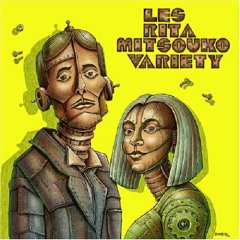
 Les Rita Mitsouko- Variety (English Version) (Because Music, 2007)


Les Rita Mitsouko were one of the biggest alternative bands in France of the 80s; a duo of Fred Chichin and Catherine Ringer who first formed and played in various Parisian art spaces in the early 80s. They were active until Chichin died of cancer in 2007-this was the last album credited to the band, an English version of their previous 2007 album Variéty.
I am a big Catherine Ringer fan- more as a musician than as an occasional porn star, admittedly. To me, she's the French version of Annie Lennox: she has a strong, distinctive voice and personality, and just generally kicks ass. The English version of Variety doesn't do her justice, and isn't really a fitting legacy for Fred.

Musically, both versions aren't the best work LRM ever did. A bit heavy on the soft-rock, nowhere near as interesting as some of their earlier work. There are some great songs on the album though: 'Ding Dang Dong' and 'Ma Vielle Ville' particularly, I love- in the original language. Variety was the first LRM album recorded in an English version,and it shows. Lyrically it's somewhat lacking. 'Ding Dang Dong' becomes a straightforward party tune with no real emotion depth; 'Ma Vielle Ville' (retitled 'Paris (France)') changes from talking about homesickness and memory to what appears to be a musical advert for the Paris tourist board.  Also, in my view Ringer just sounds better in French, like she actually means what she's singing.

Variety isn't a bad album,but it's not particularly good either. The French original is much better, as the musical shortfalls are compensated for by the lyrics. If you were to get one, I'd get that, preferably. Or even better, get Catherine Ringer Chante Les Rita Mitsouko and More à La Cigale, her post-Fred live CD of LRM songs and appropriate covers. It contains all of the good songs on Variéty, in French, and with much more energy than on disc

Friday, 11 December 2009

Dec. 11th: Somehow, I smothered rainbows


Sebastien Tellier-L'Incroyable Vérité (Record Makers, 2001)

Sebastien Tellier reminds me of Rasputin. A French Rasputin admittedly, but still. I've just realised. I've never really 'got' his music, apart from 'La Ritournelle', his best-known song. He's French (the name might be a clue...), he's a friend of Air and he makes Air-ish music, and the occasional Eurovision entry. L'Incroyable Vérité (The Incredible Truth) is a mostly instrumental album of almost stereotypically French moody noodling. It's grouped into loose 'trilogies', has an arty cover and is probably aiming to be profound; listening to it all the way through brings to mind Elton John's 'Funeral For A Friend', except about 4 times as long, with some bossa nova trumpet. I'm predisposed against this sort of thing because personally, I hate pointless noodling. And that's what this album sounds like to me: It doesn't go anywhere and doesn't really suit active listening. Maybe I should have an arty dinner party and stick it on in the background, it might work better there. The one surprising thing about this record is the scream at the end; somebody gives birth about 7/8ths of the way through,loudly. That was unexpected.
Overall: meh. C'est mood music à la francaise, something Air and many others do better than this.

Wednesday, 9 December 2009

Dec. 9th: Ne te mouche pas dans ma robe, pas cette fois. Relève-toi...


Cali- L'amour Parfait (Labels, 2004)


 Cali is a French singer and erstwhile rugby player, who'd been in various punk and alternative bands before releasing this, his first solo album, in 2004. The album's big hit, 'Elle M'a Dit' (She Told Me) is still being played on the radio, 5 years later. It was everywhere last year; I couldn't go to a supermarket without hearing it over the PA. There's a reason it was the album's biggest hit; it's by far the best song  here. The rest of it is pretty much your standard French-language chanson-influenced  adult pop; Cali's voice is pleasant, there are bits of viola and saxophone to inject a little bit of personality, it sounds like he's been listening to a lot of Radio 2.  It's not awful, it's perfectly passable, but there are 1001 French singers doing the same thing. If the lyrics were at the level of the chanson music he claims as an influence, this would be lovely. But they're the usual 'I love you, you don't love me, occasional French existential metaphor, I am so lonely without you' and therefore the album's stuck with James Morrison and Katie Melua as competition.
On the other hand, musically 'Le Grand Jour' is basically a baroque piano prelude followed by a great Handel-esque string arrangement, and 'Fais De Moi Ce Que Tu Veux' is orchestrated very well, again with a great string section.

Saturday, 5 December 2009

Dec. 5th: F.N., souffrance, qu'on est bien en France


Noir Désir- 666.667 Club (Barclay, 1996)

French rock is awful, right? The French have a reputation for their recent pop music being almost uniformly dire-and by recent i mean anything from about 1971 to the present. Most of the time, this reputation isn't entirely deserved. The language barrier is definitely to blame- a lot of French music focuses on the quality of the lyrics far more than the English equivalent would, but if you don't understand them, it doesn't matter how brilliant they are. Noir Désir (Black Desire) are probably France's premier rock band, have been active for decades and now have a rock'n' roll scandal to go with that: their frontman Bernard Cantat has just been released from prison, after serving time for murdering his girlfriend as the result of an argument.

666.667 Club went double platinum in France, and was very well received. In addition to the basic grunge template, there are gypsy violins and free jazz saxophone, amongst other things. In my opinion the band are at their best in their more politically or culturally aware songs, such as 'Un Jour En France', ridiculing the adulation of a golden-age postwar France ('les trentes années glorieuses' of modern French history) which never really was, and the slow rise of fascism (particularly that of the National Front, or F.N.) which was beginning at the time of this album. Perhaps tellingly, much of the criticism in a song which is almost 14 years old still applies to France today.
The slightly redundant English-language track which seemed to be obligatory at the time is indeed present; 'Prayer For A Wanker' (or 'woncur' as it ends up) but overall this is a very good album, musically tight and lyrically dextrous, and it even has one properly good English track, 'Lazy'. 'Un Homme Pressé' and 'Un Jour...' are the best songs by far but there is plenty here worth investigating.

Wednesday, 2 December 2009

Dec. 2nd: Salut Les Copains!


Various Artists: Sixties Girls Vol. 1 (Magic Records, 1998

This is a cheap French repackaging of four 1960s yéyé EPs by various French girl singers, of whom the best known by some margin is Françoise Hardy. Yéyé is a musical style originating from 1960s France in response to nascent American youth culture and rock and roll. There are numerous conventions which usually pop up; for example choral backing vocals, brushed drums,  French language adaptations of English hits, and fairly interchangeable singers with few writing credits to their name (the exception is Hardy, who has far transcended her yéyé beginnings).
The songs here, 16 plus a bonus track of the theme tune and jingles to 'Salut Les Copains' , one of the first French youth programmes- are all pretty much archetypal examples of high-quality yéyé, particularly Christine Lebail's 'Les Livres d'École' and 'L'an prochain sur la plage' and Christine Delaroche's 'La Porte à Coté'. All very good for dancing to and singing along-whether you know French or not.
The only slight disappointment, ironically, is Françoise Hardy's contributions; all English versions of her French hits when her English pronounciation was 'interesting'-far inferior to the originals. These serve as a terrible introduction to her work in general, most useful for trying to decode what's she's singing (e.g. 'I'm asking zee stars up a bow'). The widely available Vogue Years compilation contains all her songs here in their original forms and far more of some of the best music of its type, and of France in general.